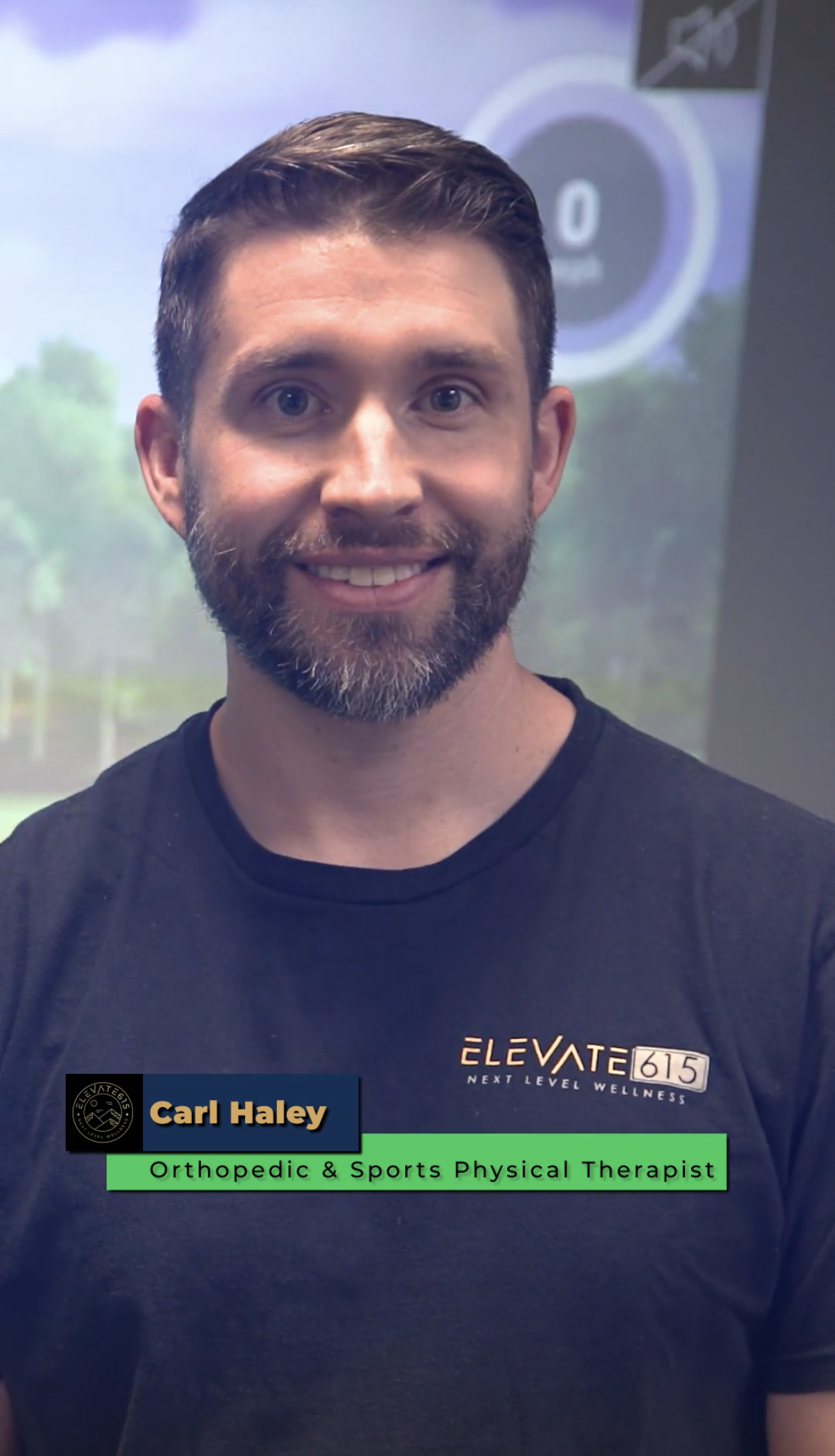
Written by TPI Certified Golf Physical Therapist in Franklin Dr. Carl Haley PT, DPT
Most golfers spend countless hours—and often thousands of dollars—on lessons, equipment, and training aids in pursuit of a better golf swing.
But what if the real reason for your inconsistency, poor ball striking, loss of distance, or lack of accuracy isn’t your swing at all?
What if it’s the one piece of equipment you’ve overlooked the entire time:
Your body.
Many golfers in Franklin, Brentwood, and Williamson County invest heavily in lessons, equipment, and range time, yet continue to struggle with consistency, distance, and recurring aches and pains. As a TPI-certified physical therapist, I often find that the missing piece isn’t another lesson—it’s identifying the physical limitations preventing the golfer from executing the swing they are being taught.
If you’ve ever found yourself saying:
- “I’ve taken a dozen lessons and still come over the top.”
- “My coach keeps telling me to rotate, but I just can’t do it.”
- “I know exactly what I’m supposed to do, but I can’t make it happen.”
- “Why does my swing always fall apart when I try to make changes?”
You’re not alone.
Many golfers assume they have a technique problem when, in reality, they may have a physical limitation preventing them from achieving the positions their instructor is asking them to reach.
Think about it this way: if your hips don’t have enough mobility to rotate, no amount of instruction can magically create that movement. If your thoracic spine lacks rotation, your body will find another way to get the club to the ball—often by developing compensations that lead to the very swing faults you’re trying to eliminate.
In other words, sometimes the swing fault isn’t the problem.
It’s the solution your body has created to work around a physical limitation.
Common Physical Limitations That Affect Your Golf Swing
The golf swing is one of the most athletic and complex movements in sports. It requires a combination of mobility, stability, balance, coordination, and power. When one piece is missing, the body compensates.
Limited Hip Mobility
The hips are the engine of the golf swing.
When hip mobility is restricted, golfers often struggle to rotate efficiently through impact. This can lead to:
- Early extension
- Loss of power
- Reduced clubhead speed
- Increased stress on the low back
Limited Thoracic Spine Rotation
The thoracic spine (mid-back) is responsible for much of the rotation needed during the backswing and follow-through.
Restrictions here can contribute to:
- Reduced shoulder turn
- Loss of distance
- Poor sequencing
- Increased compensation through the shoulders and low back
Poor Core Stability
Mobility gets you into position. Stability allows you to control it.
Without adequate core stability, golfers may experience:
- Loss of posture during the swing
- Inconsistent ball striking
- Reduced energy transfer from the ground through the club
Limited Shoulder Mobility
Shoulder mobility plays a significant role in both backswing and follow-through positions.
Restrictions can lead to:
- Difficulty achieving proper swing positions
- Reduced swing efficiency
- Compensation through the neck and spine
Ankle Mobility Restrictions
Often overlooked, ankle mobility influences balance, weight transfer, and lower-body mechanics.
Limited ankle mobility can contribute to:
- Poor balance
- Difficulty shifting weight
- Reduced power generation
- Inconsistent contact
Why Physical Limitations Often Lead to Golf Injuries
Many golfers seek physical therapy after developing:
- Low back pain
- Golfer’s elbow
- Tennis elbow
- Shoulder pain
- Neck stiffness
- Hip pain
Often these issues aren’t caused by golf itself.
They’re caused by compensations the body develops when mobility, stability, or movement control is lacking.
For example, a golfer who lacks thoracic rotation may repeatedly stress their low back trying to create rotation elsewhere. A player with poor hip mobility may overload their knees or spine over thousands of swings.
By identifying movement restrictions early, golfers can often improve performance while reducing injury risk.
What is a TPI Golf Assessment?
So how can you tell whether your struggles are caused by technique, physical limitations, or a combination of both?
At Elevate615, our golf assessment begins with the Titleist Performance Institute (TPI) Level 1 Screen.
The Titleist Performance Institute developed this head-to-toe movement screen specifically for golfers to determine whether you have the mobility, stability, balance, and movement control necessary to perform an efficient golf swing.
The goal is not simply to find what hurts or what feels tight.
The goal is to uncover the specific physical limitations that may be contributing to your swing faults.
During a TPI Golf Assessment, we evaluate:
- Hip mobility
- Thoracic rotation
- Shoulder mobility
- Core stability
- Balance
- Single-leg control
- Rotary power
- Movement efficiency
By evaluating key movement patterns, we can identify the body-swing connections that may be driving issues such as:
- Early extension
- Loss of posture
- Limited rotation
- Sway
- Slide
- Reverse spine angle
- Coming over the top
This allows us to address the root cause of the problem rather than simply chasing swing changes that your body may not currently be capable of performing.
The best golf instructors can teach you what to do.
But first, your body has to be capable of doing it.
Golf Physical Therapy in Franklin, Brentwood, and Williamson County
Whether you’re a competitive golfer trying to lower your handicap or a weekend golfer who simply wants to play without pain, identifying physical limitations can dramatically improve both performance and enjoyment of the game.
At Elevate615, we provide:
- TPI Golf Assessments
- Golf Physical Therapy
- Dry Needling
- Class IV Treatment Laser
- Golf Mobility Programs
- Golf Performance Training
for golfers throughout:
- Franklin, TN
- Brentwood, TN
- Cool Springs
- Nolensville
- Williamson County
- Greater Nashville
Our goal is simple: help you move better, play better, and stay on the course longer.
Ready to Discover What’s Really Holding Your Swing Back?
If you’ve been taking lessons but still can’t make the swing changes you’re working on, the issue may not be your technique—it may be your body’s ability to perform the movement.
A TPI Golf Assessment can help identify the mobility, stability, and movement restrictions affecting your swing and provide a clear plan to improve them.
Ready to unlock more distance, improve consistency, and reduce injury risk?
Schedule your TPI Golf Assessment with Elevate615 today and discover how Golf Physical Therapy in Franklin, TN can help you play your best golf.
Schedule Your Golf Assessment HERE
Not Ready for a Visit? Schedule a FREE Virtual Golf Mobility Profile Consult HERE
Want more blogs? CLICK HERE
Check Out Our Website and Learn what makes us the best physical therapy clinic in Franklin HERE
Learn More About our Expert Golf Physical Therapist in Franklin, TN HERE